A torn ACL (anterior cruciate ligament) is one of the most significant sports injuries an active person can face. The sudden pop, the swelling, the realization that months of recovery lie ahead—it’s a diagnosis that changes your immediate reality, and sometimes your year. Moreover, if it’s neglected then it can affect the rest of your life.
At New York Bone & Joint Specialists, we have guided athletes and active New Yorkers through every stage of this injury, from the moment of diagnosis through the final return-to-sport clearance. Our belief that preservation is the key to longevity is particularly appropriate when it comes to ACL injuries. An ACL tear leads to an unstable knee joint, and an unstable joint can lead to the degeneration of that joint. Thus, we need to make sure your knee is stable for you to have a healthy and functioning joint for a long lifetime to come.
Our approach begins with a conversation: not every ACL tear requires surgery, and when it does, the details of how it’s done determines how well you recover.
ACL reconstruction is among the most technically demanding procedures in orthopedic sports medicine. The outcome depends not just on whether the surgery is performed, but on graft selection, tunnel placement, fixation technique, and the quality of the rehabilitation that follows. Our surgeons are fellowship-trained in sports medicine, operate at Northwell Lenox Hill Hospital, and coordinate directly with our in-house physical therapy team at every stage of your care.
What Is ACL Reconstruction?
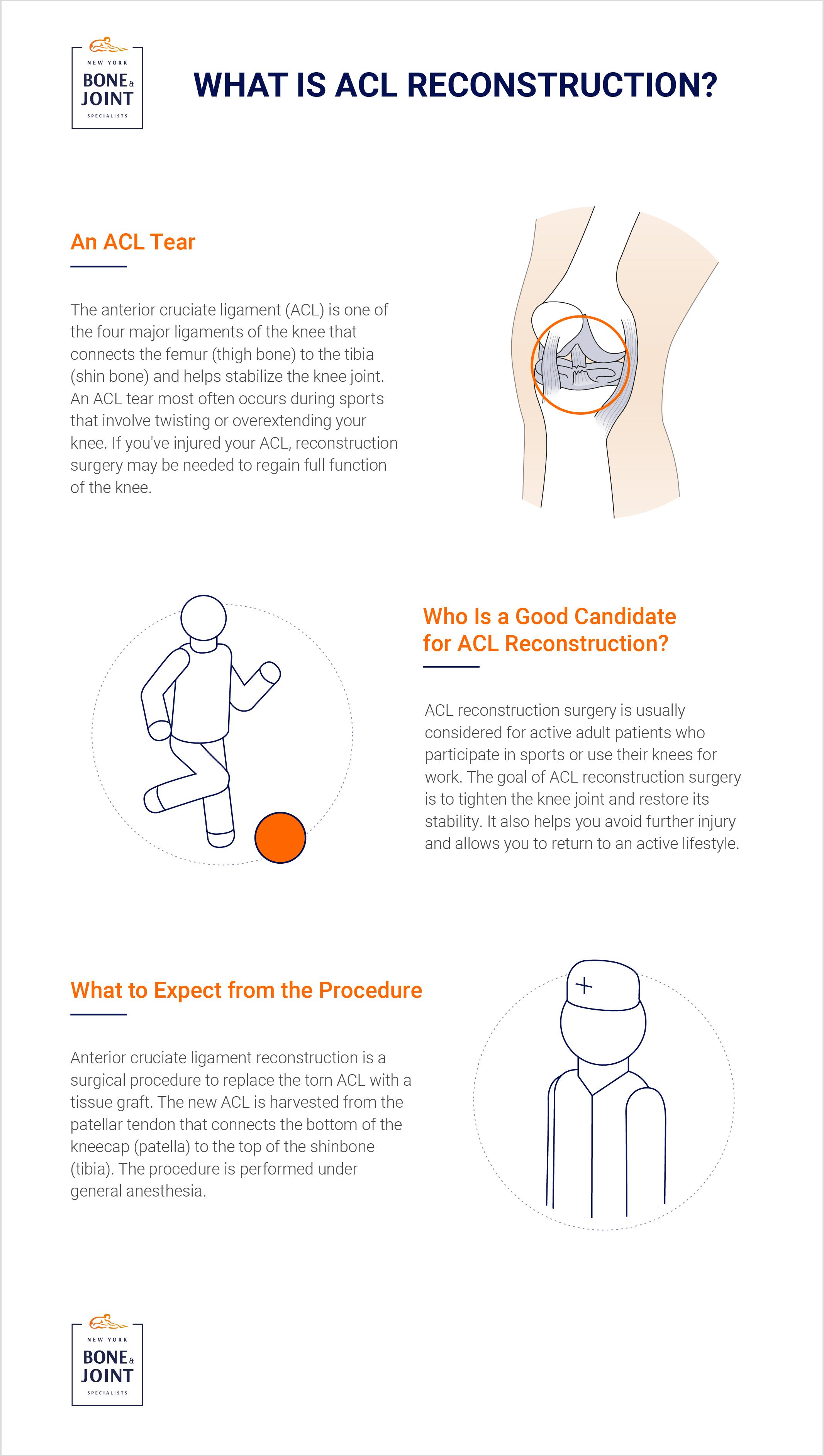
The anterior cruciate ligament (ACL) is one of the four major ligaments that stabilize the knee. It runs diagonally through the center of the joint, connecting the femur to the tibia, and is the primary restraint against rotational instability. When it tears, the knee loses its ability to handle the cutting, pivoting, and deceleration forces that are fundamental to sport and an active lifestyle.
ACL reconstruction replaces the torn ligament with a graft: a tendon taken from another part of your own body or from a donor source. The graft is then secured inside bone tunnels drilled in the femur and tibia. Over the following 12 to 18 months, the graft undergoes a process called “ligamentization” where it gradually transforms from transplanted tendon into a functional ligament, developing the mechanical properties needed to stabilize the knee under load.
The procedure is performed arthroscopically (a minimally invasive technique with small incisions using a camera and specialized instruments) which lessens tissue disruption, reduces post-operative pain, and accelerates early recovery compared to open surgical approaches.
Are You a Candidate for ACL Reconstruction?
Not every ACL tear requires surgery. The decision to undergo surgery depends on your age, activity goals, the severity of your instability, and whether you have concurrent injuries to the meniscus or cartilage. At your consultation, we will review your MRI, assess your knee stability, and discuss surgical and non-surgical options available to you so you can make an informed decision.
ACL reconstruction is typically recommended when:
- You have a complete ACL tear confirmed on MRI and clinical examination
- You participate in pivoting or cutting sports and intend to return to them
- Your knee gives way during daily activities or lower-level sport
- You have a concurrent meniscus tear that requires repair and benefits from the stability of a reconstructed ACL
- You have tried physical therapy and activity modification but continue to experience instability
Non-surgical management may be appropriate for older, less active patients or those with isolated tears and minimal instability. We will present both pathways honestly. If surgery is not your best option, we will tell you.
Note: New patients with ACL injuries
Same-day consultations are available at our Upper East Side and Midtown locations. Bring any existing MRI or X-ray imaging to your first visit. If imaging has not been obtained, we can arrange it in-house.
Graft Selection: The Most Important Decision Before Surgery
The choice of graft is one of the most consequential decisions in ACL reconstruction, and it is one that should be made with your surgeon based on your anatomy, age, sport, and recovery goals—not as a default. There is no universally superior graft. Each has distinct mechanical properties, harvest-site implications, and evidence behind it.
| Graft Type | Best For | Key Advantage | Consideration |
| Patellar Tendon (BTB) | High-demand athletes, contact sport, revision cases | Highest mechanical strength; gold standard for return to pivoting sport | Anterior knee pain possible; kneeling discomfort in early recovery |
| Hamstring Tendon (Autograft) | Patients prioritizing anterior knee comfort; recreational athletes | Less donor site morbidity; good outcomes in recreational population | Slightly higher re-tear rate in young athletes returning to cutting sport |
| Quadriceps Tendon | Larger patients; revision ACL; patients with prior patellar tendon harvest | Large graft cross-section; excellent option when other autograft sites are unavailable | Less commonly used; growing evidence base |
| Allograft (donor tissue) | Older, lower-demand patients; multi-ligament reconstructions | No donor site; useful in complex multi-ligament cases | Higher re-tear rate in patients under 25; not recommended for young athletes |
At New York Bone & Joint, graft selection is an individualized conversation, not a default. We review your age, activity level, sport, and anatomy together and arrive at the choice that optimizes your long-term outcome.
The Procedure: What Happens in the Operating Room
ACL reconstruction at New York Bone & Joint is performed as an outpatient procedure under regional or general anesthesia. Patients go home the same day. The surgery typically takes 60 to 90 minutes.
The key steps:
- Graft harvest: If using an autograft (your own tissue), the graft is harvested through a small separate incision. The harvest site is repaired carefully to minimize donor site complications.
- Arthroscopic joint preparation: A camera is inserted through two small portals to inspect the joint, confirm the ACL tear, and address any concurrent injuries to the meniscus or cartilage at this time.
- Tunnel drilling: Bone tunnels are drilled in precisely measured anatomic positions in the femur and tibia, replicating the native ACL footprint. Tunnel placement is the most technically demanding step and has the greatest influence on rotational stability outcomes.
- Graft passage and fixation: The graft is passed through the tunnels and fixed at both ends using hardware appropriate to the graft type. Graft tension is carefully set before fixation to optimize stability without over-constraining knee motion.
- Closure and dressing: Portals are closed and a post-operative dressing and brace are applied. Most patients bear weight on the leg before leaving the facility.
Concurrent procedures: Meniscus tears, cartilage lesions, and partial MCL injuries are commonly identified and addressed in the same operative session. We will discuss any anticipated concurrent procedures with you in detail before surgery.
Recovery & Rehabilitation: Phase by Phase
ACL reconstruction recovery is a process, not an event. Most patients return to sport between 9 and 12 months—and the quality of the recovery program matters as much as the surgery itself. At New York Bone & Joint, your surgeon and physical therapist work in the same center and communicate directly at every milestone.
| Phase | Timeframe | Goals & Activities |
| Phase 1 | Weeks 0–6 | Swelling control, restore range of motion, begin quad activation. Weight-bearing as tolerated with crutches. Brace worn for protection. Physical therapy begins within the first week. |
| Phase 2 | Weeks 6–12 | Full weight-bearing without crutches. Progressive strengthening of quads, hamstrings, and hip stabilizers. Stationary bike and pool exercises. Brace weaned. |
| Phase 3 | Months 3–6 | Jogging progression, lateral movements, sport-specific conditioning. Strength and symmetry testing begins. Single-leg assessments performed. |
| Phase 4 | Months 6–9 | Agility training, sport-specific drills, reactive neuromuscular exercises. Functional testing including hop tests and strength indices. |
| Return to Sport | 9–12 months | Criteria-based clearance, not time-based. Requires: limb symmetry index >90%, passing hop test battery, psychological readiness assessment, surgeon and physical therapist sign-off. |
New York Bone & Joints’ return-to-sport protocol
We do not clear patients for return to sport based on time alone. Clearance requires objective functional testing—including single-leg hop tests, quad and hamstring strength symmetry indices, and a psychological readiness assessment. Research consistently shows that criteria-based clearance reduces re-tear risk compared to time-based clearance alone.
Risks & Considerations
ACL reconstruction is a well-established procedure and like any surgical procedure there have been complications reported. New York Bone & Joint believes that advanced surgical skills, an experienced full scope of knowledge, detailed understanding and unwavering care for the patient’s wellbeing are the keys to minimizing complications. We discuss these with every patient in detail.
- General Data for Re-tear: The general reported data shows a re-tear rate for ACL reconstruction ranging from 4.4% to 10% in the general population and higher (15–25%) in the very young athletes returning to cutting and pivoting sport.
Surgeons at New York Bone & Joint make every effort to minimize the re-tear rate. Important factors to do so includes the orthopedic surgeon’s experience, the graft choice, the patient age, tunnel placement, and adherence to rehabilitation protocol. Moreover, we utilize post-operative neuromuscular training which the American Orthopedic Society of Sports Medicine (AOSSM) advocates to decrease re-tear rate
As a result, according to our own surgical outcome data, New York Bone & Joint has an ACL re-tear rate of approximately 1-3 %. Of course, published data is the industry standard.
- Donor site morbidity: Autograft harvest can cause temporary discomfort at the harvest site (anterior knee pain with patellar tendon graft; hamstring weakness with hamstring graft). Sometimes some patients develop numbness at the harvest site. Most patients fully resolve these issues by 6–12 months.
- Stiffness: Arthrofibrosis (excessive scar tissue formation causing stiffness) is uncommon. It is minimized by early motion and supervised physical therapy. Key factor- the better motion pre-operatively the better motion post-operatively. Our surgeons at New York Bone & Joint often incorporate pre-operative physical therapy in a structured setting to regain optimal range of motion before proceeding with the surgical reconstruction
- Infection: Surgical site infection occurs in less than 1% of cases. All our procedures follow strict sterile protocols.
- Anesthesia: Standard anesthesia risks apply. These are reviewed with your anesthesiologist before surgery.
- Non-surgical alternative: For low-demand patients without instability, a structured physical therapy program focused on neuromuscular rehabilitation and quad strengthening can allow return to activity without surgery. We will discuss this option if it applies to you.
Why Choose New York Bone & Joint for ACL Reconstruction
| Why NYBJ | What It Means for You |
| Individualized graft selection | No default approach. Your age, sport, anatomy, and goals determine graft choice. Discussed in detail at your consultation. |
| Fellowship-trained knee surgeons | The orthopedic sports medicine surgeons at New York Bone & Joint have completed subspecialty sports medicine fellowships at some of the most competitive programs in the country, including NYU Langone Orthopedic Hospital. |
| Minimize Re-tear Rates | Surgeons at New York Bone & Joint combine experienced surgical expertise and strict criteria-based rehabilitation to keep re-tear rates at a minimum. |
| In-house physical therapy | Your surgeon and physical therapists work in the same centers. Protocol is coordinated from day one of recovery, not handed off to a separate facility. |
| Criteria-based return-to-sport clearance | Objective functional testing determines when you are ready to return, not a calendar. This matters for re-tear prevention. |
| Concurrent injury management | Meniscus tears, cartilage lesions, and MCL injuries are assessed pre-operatively and addressed in the same surgical session where appropriate. |
| Same-day consultations | Patients with acute knee injuries can be seen the same day or next day. Diagnostic testing such as X-ray and ultrasound is done on the first visit. An MRI can be ordered immediately, via concierge MRI scheduling, so that all information will be available for a clear plan as soon as possible. |
| In-house imaging | X-ray and Ultrasound is available at both locations. Concierge MRI scheduling is immediately available. |
Frequently Asked Questions
Do I need surgery for a complete ACL tear?
You don’t have to do ACL surgery if you don’t want, but for most active patients who want to return to pivoting and cutting activities, surgery is the most reliable path. Non-surgical management works best for lower-demand patients or those with minimal instability. In our experience, most active and healthy people benefit from ACL surgery because it is difficult to live and function with an unstable knee. Moreover, a knee with a torn ACL (that is not “fixed”) has an increased risk of developing meniscus (cartilage) tears which then leads increased risk of osteoarthritis. Moreover, according to the American Academy of Orthopedic Surgery (AAOS) clinical practice guidelines, ACL reconstruction is recommended for active patients with complete tears who wish to return to pivoting activities.
At your consultation, we will review your MRI, assess your instability, and discuss both pathways based on your specific goals.
Which ACL graft is best: patellar tendon, hamstring, or quad?
There is no single best graft. Patellar tendon grafts provide the highest mechanical strength and are preferred for young, high-demand athletes returning to contact or cutting sport. Hamstring grafts offer less donor site discomfort and perform well in recreational patients. Quad tendon grafts are an excellent option in revision cases or when other sites are unavailable. Cadaver grafts (allografts) are also an option, but it is not recommended for those under the age of 30 because of high re-tear rates. In our surgeons’ experience, we usually prefer to use your own tissue graft (autograft) instead of an allograft because we believe that, typically, the best tissue is your own tissue. Nevertheless, we review graft choice individually with every patient—it is one of the most important decisions in the process.
How long does ACL reconstruction recovery take?
Most patients return to sports between 9 and 12 months, though the timeline varies based on the graft used, concurrent injuries addressed, patient age, and adherence to the rehabilitation protocol. Returning to daily activities and low-impact exercise typically happens by 3 to 4 months. Return to running begins around 4 to 5 months. Sport-specific training starts at 6 to 9 months. Clearance for return to full sport requires passing objective functional testing, not just reaching a time milestone. In short: the graft needs time to incorporate and heal but your muscles also need to regain full strength and balance. Return to sports occurs when both things happen.
When can I return to sport after ACL reconstruction?
We use a criteria-based return-to-sport protocol. Clearance requires a limb symmetry index above 90% on strength testing, passing a single leg hop test battery, and time. This typically occurs between 9 and 12 months. Studies show that utilizing strict criteria instead of time alone significantly lowers rates of re-tear.
What happens if I don’t have ACL surgery?
Some patients do well without surgery, particularly those with low physical demands and adequate knee stability. However, a chronically ACL-deficient knee (one that gives way repeatedly) is associated with an increased risk of meniscus tears and early-onset knee arthritis. If you have instability symptoms or a concurrent meniscus tear, delayed surgery can worsen long-term outcomes.
In our experience (and confirmed by studies), delaying ACL reconstruction for up to 6 months may be acceptable but a delay of more than 6 months significantly increases the risk of tearing your meniscus. The meniscus protects the articular cartilage that lines the joint. Arthritis sets in when that articular cartilage is lost. Therefore, we want to preserve your ACL and your meniscus for the long term health of your knee joint.
During your consultation we will be direct with you about your individual risk profile.
Can I have ACL reconstruction and meniscus repair at the same time?
Yes. We inspect the entire knee joint during the ACL reconstruction. If we find a meniscus tear, then we would most definitely address it by making every effort to repair it in order to preserve the integrity of your joint. Meniscus tears are present alongside ACL tears in 40 to 70 percent of cases. A repaired meniscus has a higher rate of healing when it is repaired at the same time of the ACL reconstruction. This is because the drilling during ACL reconstruction releases precious stem cell material that is essential for healing. We, of course, assess the meniscus on the pre-operatively MRI. It is not uncommon that the meniscus tear is not clear on the MRI, but we can see it during the ACL reconstruction with direct arthroscopic visualization.
What is the re-tear rate after ACL reconstruction?
The overall reported data shows re-tear rate ranging from 5 percent in general population to even 25% young athletes (under 25) returning to high-demand cutting and pivoting sports. Based on our surgical outcome data, New York Bone & Joint surgeons’ rate of re-tear is approximately 1%
We minimize the risk of re-tear utilizing our surgeons’ experienced skill, appropriate graft selection, tunnel placement accuracy, and neuromuscular rehabilitation criteria based progression to return to sports.
Case Observation
I have had the honor of performing ACL reconstructions for 20 years for professional athletes, recreational sports enthusiasts, and everyday people.
One of the most rewarding experiences is reconstructing an ACL for someone who needs daily function restored so that they are able to work, earn a living, and support their family. One of my very first patients required an ACL reconstruction. He recently returned to me for a different issue. During his return visit, he explained how the ACL surgery allowed him to return to providing for his family, who he clearly cared about very much. He showed me a picture of his beautiful family and I saw his happy face. I felt such gratitude that I was able to become a doctor and a surgeon in order to help this kind man and his family.